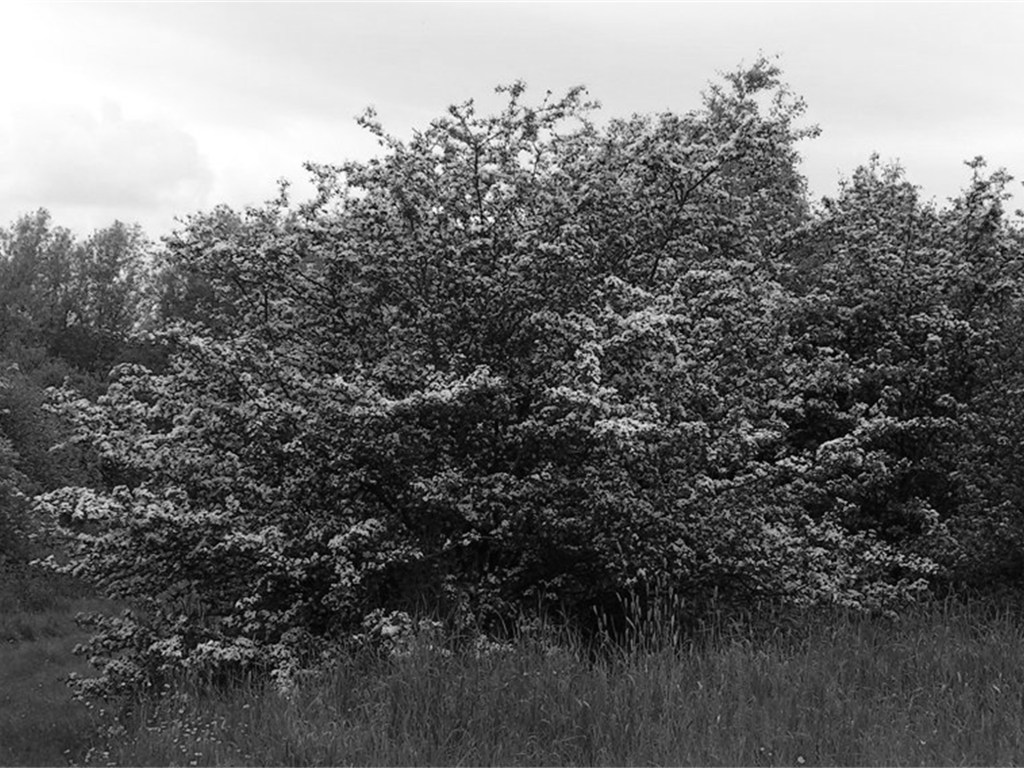
Believe it or not, this ancient grove of hawthorns has inspired more poets than any other stand of trees in the world. Just look at this long list of writers who have fallen under its spell over time! One of them, a local poet named Thaddeus Quillsworth, The Knickerbocker literary magazine acknowledged in the 1850s for his poem about this place, which he called, simply, “A Hawthorn”—
In the dance of shadows beneath the moon,
Where secrets linger in the haunting swoon,
A hawthorn stands, a spectral silhouette,
Its branches twisted, a dark minuet.
Thorny fingers reach out with ghostly grace,
Labyrinth of whispers in quiet embrace,
Each twist and turn a sad tale untold,
In the language of thorns, myst’ries unfold.
Moonlight weaves through the thick and twisted maze,
Symphony of shadows, nocturnal haze,
With mistletoe and celestial gleam,
The hawthorn dreams up spectral scheme.
In this night garden, where enchantment weaves,
Thorns become verses, and whispers from leaves,
A lament of sorrow, a darkened art,
Hawthorn’s burning embrace, a broken heart.
Legend has it that these hawthorns are the direct descendants of trees planted centuries ago along this divide. Ask anyone nearby about them, and they’ll tell you the story of Lorcan Lupracan, a Jo-ga-oh of the First People who stowed away in a trunk on a Spanish galleon bound for the New World and, in pursuit of treasure, eventually found his way to this place. On this very spot, they say, he emptied a pocketful of crimson haws from County Cork to make room for the potful of gold awaiting him at the end of a colossal rainbow.
The hawthorns that sprung from the seeds were of a kind that no one in this part of the world had ever before seen, a dense thicket of twisted thorny branches and bewitching clusters of delicate pink and white blossoms that filled the air each spring with the pungent odor of musk. Around here, you can still catch a whiff long after peak bloom. Prick yourself on the one magic thorn on each tree, and like Lorcan, you will become rich. Prick yourself on any of the others, and heartbreak will be your fate. Or worse!
Venture about a half mile or so to the right of this spot, and you’ll come to Eight Mile Creek, one of many spring-fed streams that weave northward towards Great Lake. Venture about the same distance to the left, and you’ll reach Townley Run. Like many other streams on that side of the divide, Townley Run zigzags to the headwaters of the Great River about a hundred miles to the south.
The First People believe that at this very spot, the Great Spirit banished the twin Earth-Sons to a lonely existence as punishment for egregious offenses they’d committed together. As the twin brothers, clearly devastated, set off in opposite directions into the wilderness, the tears of their Sky-Mother followed them, creating the springs and streams that form the two watersheds that make this area unique and that to this day sustain the vine growers to the north and the truck farmers to the south. Quillsworth committed this tale to verse, too. He wrote—
In realms where celestial spirits hold their sway,
The Great Spirit ruled, in realms so far away.
Two Earth-Sons, twins, in mischief sought delight,
Igniting storms and causing endless night.
With thunderous voice, the Great Spirit spoke,
Their reckless deeds, a cosmic oath he broke.
To wilderness vast, the banishment decreed,
A lesson stern, for their wild hearts to heed.
Across the hills and through verdant vales,
The Earth-Sons fled, forging differing trails.
In their hearts, a longing for the past,
A home in the heavens, a love too vast.
The Sky-Mother wept, her tears like silver streams,
A cascade of sorrow, birthing liquid dreams.
Down from the heavens, a torrential rain,
Each droplet a lament, a celestial pain.
The streams of sorrow, tracing paths unknown,
Became the rivers, the wild currents grown.
Reflecting the Sky-Mother’s tearful gaze,
They flowed through the wilderness, in intricate maze.
Over there, just beyond the hawthorns, is Mistleton. A man named Beaman Mistleton built it as a tavern around 1810, but over the course of a few generations it went from being a tavern to a farmhouse, which it remains today. In her 1976 unauthorized biography of the Mistleton family, the local historian Penelope Quillsworth—no relation to the poet—said that Beaman built the tavern on the site, betting that a planned east-west road across the county would run parallel to the divide and along the edge of his property. Instead, they laid out the road a mile or so to the south, bypassing the Mistleton property completely.
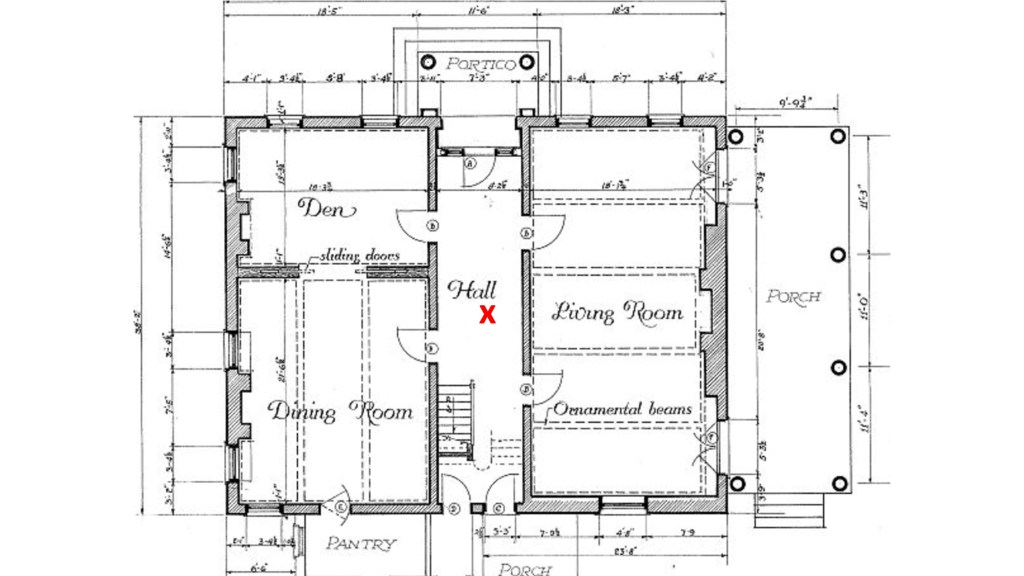
But here’s something about the house that you won’t find in her book. Situated as it is across the divide, they say that if you drop a marble or other round object in the center of the main hallway, it will roll to one end or the other because of the divergent gravitational pulls of the two watersheds. In fact, the Mistletons used to settle disputes and make decisions by dropping a musket ball and watching which way it rolled. That’s how the Mistleton girls used to choose between suitors, believe it or not! One of them even had her two wooers stand at opposite ends of the hallway when they both showed up at the same time one December eve and let a glass Christmas ornament she plucked from the tree decide whose hand to accept.
Before dropping the musket ball, glass ornament, or whatever orb they had in hand, the Mistletons would recite this incantation—
By the dance of gravity, and the whims of fate,
In the roll of this sphere, my choice shall dictate.
As it descends, whispers from realms untold,
Guide my decision, let destiny unfold.
To the left or right, where the path may lead,
In the ball’s descent, my choice I shall heed.
As it tumbles and turns, so shall my way,
In this mystical moment, let destiny sway.
You can see the spot where they performed their ritual on this floor plan of the house. Here, I’ll pass it around. It’s where the red X is.
No one could ever prove it, but people in town suspected the Mistletons of witchcraft. Some of them still do. When you think about the enchanted hawthorns, this house with its supernatural hallway, the poems written about this place over the years, and all the gases and electromagnetic energy released along this stretch of the continental divide, you can begin to understand their suspicions.
So, instead of over-exposing ourselves to gases or rays or falling under a Mistleton witch’s spell this Hallow’s Eve, let’s head back to town and finish our tour, maybe even over something to drink or a delicious locally sourced meal at the Tangled Vine!
 Mistleton and Other Men
Leave a comment