While searching one afternoon for table linens for Thanksgiving, Woody discovered a tattered black-and-white photograph tucked away at the back of one of the two mahogany buffet cabinets in the dining room. The photo, a street view from the 1920s with “Main Street” handwritten in faded pencil on the back, revealed that, even before it became the Crooked Smile, the Tangled Vine was known as the Mistleton Apothecary and included the neighboring building that until recently housed the Glamour Palace. Woody could see a faint, ghostly outline of the photographer standing next to his large format camera reflected in the window glass, but he couldn’t make out any of the facial features.
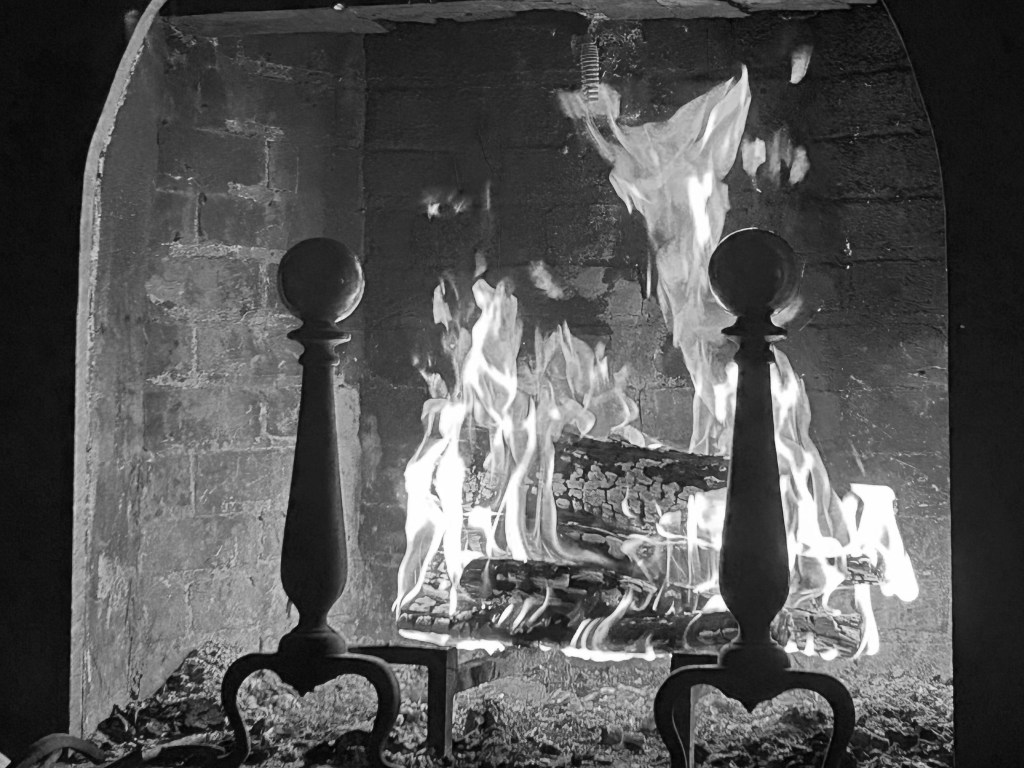
Curious about the history and already thinking about how to tweak the tour, Woody asked Mistleton about the photo that evening. Although Mistleton was not usually one to talk about himself, least of all his family, the wine from dinner left him feeling uncharacteristically open, and he acquiesced. He grabbed the crystal decanter and two glasses from the sideboard, gestured Woody towards the leather sofa in the den, threw a dried log on the fire, and sat down at the other end, gently brushing Woody’s leg with his as he passed by him. Woody felt a sudden tingle surge up his leg, tracing a path along his spine to the nape of his neck. Was it a hopeful sign of things to come for the two of them tonight? He’d find out eventually.
Mistleton removed the stopper from the decanter and poured a measure of Armagnac for each of them. He handed Woody a glass, then raised his own, locking eyes with him. “Santé,” he said. “Clue number two,” Woody thought. Mistleton leaned back on the sofa and took a sip.
“My great-grandfather was somewhat of a visionary. Back in 1904, after the phylloxera epidemic nearly wiped out grape growing in the area, he decided to diversify the family’s financial portfolio. So, he opened a shop. He focused mainly on selling medicines made from herbs and plants available here on the farm. When Prohibition hit, he took advantage of some legal loopholes and ramped up the production and sale of medicinal alcohol.
“But that wasn’t all. He also stocked over-the-counter remedies and tonics that, like kava, could mimic alcohol’s effects. It was a clever workaround, I’ll grant him that. People who came to his shop could still experience drunkenness, even if it wasn’t quite what they were used to.”
Mistleton paused for another sip of his Armagnac. Woody, still studying him closely, waited in silence.
“And he didn’t stop there. In 1928, he opened a speakeasy in a room behind the storefront next door, where they sold grape moonshine and other homemade spirits. He put my great uncle in charge of it. He was just 22 at the time but a good distiller, or so they said. As a council member, my great-grandfather felt confident that he could provide the necessary cover in case anything went wrong.”
As Mistleton delved deeper into his family history, Woody found his attention shifting from the handsome man sharing the sofa with him to the tale the man was telling. He did his best to appear attentive and calm, but his mind buzzed with a swarm of new ideas: a Prohibition-themed tour, one centered on medicinal herbs, and maybe another highlighting the Mistleton family in the 1920s. Perhaps—just perhaps—the Vine could even shift toward telling true stories rather than relying so heavily on fantasy and make-believe. Both Julian Vex’s and his own creative ideas had brought them this far, but Woody doubted the long-term viability of a tour built on deception. As quirky as the stories were, people would eventually get tired of them and seek something new. He nudged Mistleton for more details.
“What was your great uncle’s name?”
“Bushman, same as mine, but people called him Cerf. ‘Curious about his own desires for other men,’ as my grandmother used to say, he created a discreet after-hours environment where people met for drinks and underground sex. As strange as it may seem, that’s where he met the love of his life, a handsome man his age who, as only fate would have it, worked at Mistleton as a farmhand.”
With each new detail Mistleton revealed, Woody’s curiosity deepened, prompting him to ask more questions.
“What was his name, Bush?”
“I don’t remember exactly. Hudson, maybe? The chemistry between them was palpable. There wasn’t a single building or field on this farm where they didn’t secretly explore each other’s depths.
“They experimented with different herbs and plants in search of an aphrodisiac. Or that’s the story, at least. They eventually produced one made from ingredients right here on the farm—a concoction of hawthorn fruit, ginseng, mistletoe, and nettle that produced the emotional high and feelings of euphoria they were looking for, while at the same time increasing their stamina and the power of their release.”
Woody shifted his position slightly to hide the protuberance forming in the crotch of his jeans. Mistleton had a way with euphemisms, which he found irresistible. He dropped another question.
“You mean, like ecstasy?”
Mistleton grabbed the Armagnac and poured another glass.
“No. More like ecstasy mixed with sildenafil and apomorphine.”
“Okay, Heisenberg, can you translate?” Woody asked, his tone somewhere between a tease and a plea.
“Viagra and a dopamine booster, basically. They were ahead of their time.”
“For sure. So, what ever happened to them?”
“A man in town on business caught the two of them in the act in the men’s room of the speakeasy and threatened to go to the sheriff. My great-grandfather intervened and took care of things somehow, but he fired the farmhand and sent my great uncle to Europe to end the relationship.”
As the mood darkened, their conversation took a somber turn, sapping the energy in Woody’s jeans. Woody suspended his search for clues. Leaning in to show compassion, he softened his voice and continued his questions, assuming—strangely, he realized—the role of a victim advocate.
“How did your great uncle end up inheriting the farm, and not your grandfather?”
“My great-grandfather disapproved of his oldest son’s homosexuality. He didn’t disown him. And my grandfather was no agriculturalist.”
“And your great-grandmother?”
“My great-grandmother was heartbroken. She visited him a couple times in Europe, but he didn’t come back here until my great-grandfather’s funeral.”
Both men took another sip.
“You’re probably wondering what became of his lover. No one in my family talked about him. I assume they didn’t know and didn’t care to find out.”
Woody paused his questioning, reflecting on the tragedy that Mistleton had just laid before him. What struck him were the parallels to some of the outrageous stories Vex had woven into the tour: the Great Spirit separating the twin Earth-Sons due to egregious offenses, the Sky-Mother—in tears—following them, the musky and magical hawthorns, and the suspicions surrounding the Mistletons’ alleged witchcraft. All of it, combined with the Armagnac, left Woody uncertain about his own reality.
“How do you know all this?”
“Maybe from all the stories I heard and the conversations my parents and grandparents had when I was young. Out of respect for my family and for me, please don’t tell anyone what I just told you, especially not Vex. Knowing him, he’ll want to do something with it and ask you to generate another poem.”
“If that were to happen, we’d have to give it an X rating. What other skeletons does the Mistleton family have in its closet?”
“Believe me, you don’t want to know,” Mistleton murmured, his eyes drifting to the fire, as if the flames could burn away whatever haunted his thoughts.
As the fire flickered and dimmed, Mistleton rose from the sofa and returned the decanter to the sideboard. He turned to Woody as he made his way towards the staircase in the hall.
“You coming up?”
“I will in a few minutes, Bush. I’ll take the glasses and dirty dishes to the kitchen and close everything.”
That was definitely a sign if Woody had ever seen or heard one—more than that, it was an invitation. He should have left the damn dishes on the dining room table and followed Mistleton willingly up the stairs, but he was still processing what had just happened. A delay of a few minutes shouldn’t make much of a difference, or so he thought.
Besides the parallels with the tour, Woody zeroed in on the similarities between Mistleton and his great uncle. Both were attracted to other men, spent time in Europe, and eventually returned to the farm. Whereas Cerf, his great uncle, was a distiller, Mistleton was a chemist—a distinction in title only, as both fields demanded a command of mixtures, measurements, and the patience to wait for the right reactions to unfold. Genetics would explain some of Mistleton and his great uncle’s shared traits like same-sex attraction, but their upbringing at this place, in the same family, might also lay behind the similarities.
It took longer than a few minutes for Woody to process their conversation and to ensure that everything was squared away in the kitchen and the rest of the house. He climbed the stairs to the second floor and made his way directly to Mistleton’s bedroom. He tardily slipped into bed beside him, placed his hand on Mistleton’s groin, and started stroking his frenulum lightly with his index finger. On the verge of sleep but acutely responsive to Woody’s touch, Mistleton stirred just enough to murmur, “What are you doing, Woody?”
“This one’s on me, Bush,” Woody whispered. “I’m giving your story a happy ending.”
 Mistleton and Other Men
Leave a comment