The next morning, while Mistleton helped Hunter with something in the barn and then went for a ride, Woody took advantage of the time alone to explore the house. Either on his own or with Mistleton, Woody had spent hours in many of the rooms since his arrival on the farm, but the revelations of the previous night had aroused his curiosity about the history of the Mistleton dynasty. Now, he treated virtually every object in the house as a piece of a larger puzzle.
The den where Mistleton opened up about his family was a cozy space with inviting décor. The golden tan walls displayed framed photographs alongside 18th- and 19th-century etchings, lending a sophisticated and personal touch to the room. A casually draped tan and red wool throw added a relaxed feel to the rich brown leather sofa where they had sat, while a bold red armchair across from it introduced a vibrant splash of color. Near the window, two upholstered chairs created an intimate sitting area. The soft grey-green soapstone mantel surrounding the fireplace showcased the Mistletons’ collection of copper luster pitchers, and above them, a softly gilded bull’s-eye mirror reflected the room, adding depth and elegance. A deep red Persian rug anchored the furniture and enhanced the warmth of the space, which exuded comfort with its vintage, lived-in charm.
Grand in scale, the central hall extended about 33 feet from the entrance portico to the main staircase and two doors at the back. One door led to a late 19th-century extension housing the kitchen, a pantry, and bathrooms above, connected by a service stair, while the second opened to a small kitchen garden filled with herbs and summer vegetables. Painted in a soft light blue that complemented the den and adjacent rooms, the hall served as a transit corridor, a gallery of Mistleton family portraits and European and American landscapes in mismatched gilded frames, and a furniture depot for a collection of side chairs and drop-leaf tables. When cleared of the lamps, candlesticks, decorative bowls, and other objects, these tables could be pulled away from the walls and arranged lengthwise to accommodate 22 for dinner.
Two items in the hall that had gone unnoticed since Woody’s arrival at the farm attracted his attention this time around. One of them was an early 20th-century portrait of Cerf Mistleton, the great uncle, whom Mistleton resembled. The other was a matte-finished gray flint stone sphere of about two inches in diameter displayed on a drop-leaf table midway down the hall.
His curiosity piqued, Woody picked up the sphere in his left hand and positioned himself in the center of the hall. Bending slightly and lowering his arm so that the tip of his thumb was about a foot and a half above the wooden floor, Woody released his grip on the sphere and let it drop. To his amazement, the sphere rolled down the middle of the hall, hitting the front door just as he heard the first of three knocks coming from the other side. Woody walked to the entrance, picked up the sphere, and clenched his fist around it to conceal it. He looked out through one of the sidelights and then opened the door. It was Holly.
Born and raised in Oxford Springs, a village located just south of the county line about 20 miles from Mistleton, Holly Reese was the proud descendant of Scotch-Irish immigrants who settled in the area about the same time as Beaman Mistleton and took up farming. She earned her degree in hotel and restaurant management at the local university and then worked as the assistant director of the cafeteria program for the local school district. After three years, she left the job to take over the management of the Tangled Vine where, she joked, she could slowly poison the parents instead of poisoning their kids.
Holly was compact and rather round, with bushy orange hair that matched her persimmon freckles and ruddy complexion. She was simultaneously rough-edged and kind-hearted, an unlikely combination of personality traits so in tune with the harsh climate and natural beauty of the region that she and her kind—and there were a lot of her kind around—could have sprouted from the area’s fertile yet rocky soil and still turned out the same.
“Hey Woody. Mistleton asked me to drop off these labels. Is he around?”
“Hi Holly,” he replied, leaning casually against the doorframe. “He’s with Hunter somewhere on the farm, but I can give them to him.” Woody glanced at the envelope containing the labels, raising an eyebrow. “What’s he doing with these, anyway? He usually steers clear of anything tavern related.”
A wry smile crossed Holly’s lips. “Your guess is as good as mine. You know him, Woody. Who knows what’s in his head. Maybe something to do with the Glamour Palace building, now that he’s put in an offer.”
Woody raised an eyebrow, intrigued. “An offer?”
“Why, yes. He told you, right? He’s trying to buy it from Stella’s estate. I’m guessing some kind of fancy candy store, based on these labels. Well, I’ll let you sort it out with him. I have to get back to the tavern for the lunch rush.”
“Okay, thanks. We’ll see you later then?”
“Definitely for Thanksgiving. Can I bring anything?”
“Thanks, but I think we’ve got it pretty much covered.”
“Okay, well, let me know if you change your mind. Hi to Mistleton. Bye.”
Woody watched Holly hoist herself up into the cab of her Ford F-150 and drive away. He closed the door, so intrigued by what Holly had told him that he forgot all about the sphere in his hand and how it rolled down the hall. If the envelope Holly handed over hadn’t been sealed, Woody would have looked right away to see what Mistleton was up to, but he knew better than to open Mistleton’s mail. He’d have to coax the information out of him somehow. He placed the envelope on one of the tables, put the stone sphere back on its stand, and resumed his first-floor search.
Like the hall, the living room at Mistleton extended from the front to the back of the house. Two paned French doors, one on each side of a large white marble fireplace, led out to a generous columned porch with an unobstructed view of the farm’s hawthorns. The room itself was both rustic and elegant, with exposed ornamented wooden beams on the ceiling, a bold yet simple white cornice and corresponding baseboard, and matching milled and painted door and window trim.
The soft lighting from two chandeliers and wall sconces, combined with the light terracotta-colored walls, gave the room a warm, intimate ambiance that belied its large dimensions. The furnishing and décor followed the same formula as those in the den, albeit in different hews and styles. Dark wood tables and case furniture—many of them cherry and others possibly black walnut—offset the upholstered slipper and other chairs adorned with matching or contrasting accent pillows or draped with throws. As in the hall, portrait and landscape paintings set in gilded frames adorned the walls, some of them in tiers of two or even three. A large and elaborate gilt peer mirror amplified the light of the silver and brass candlesticks on the mantle. The dark blue and salmon-colored Persian rug on the floor added texture and supplied nearly all the pattern.
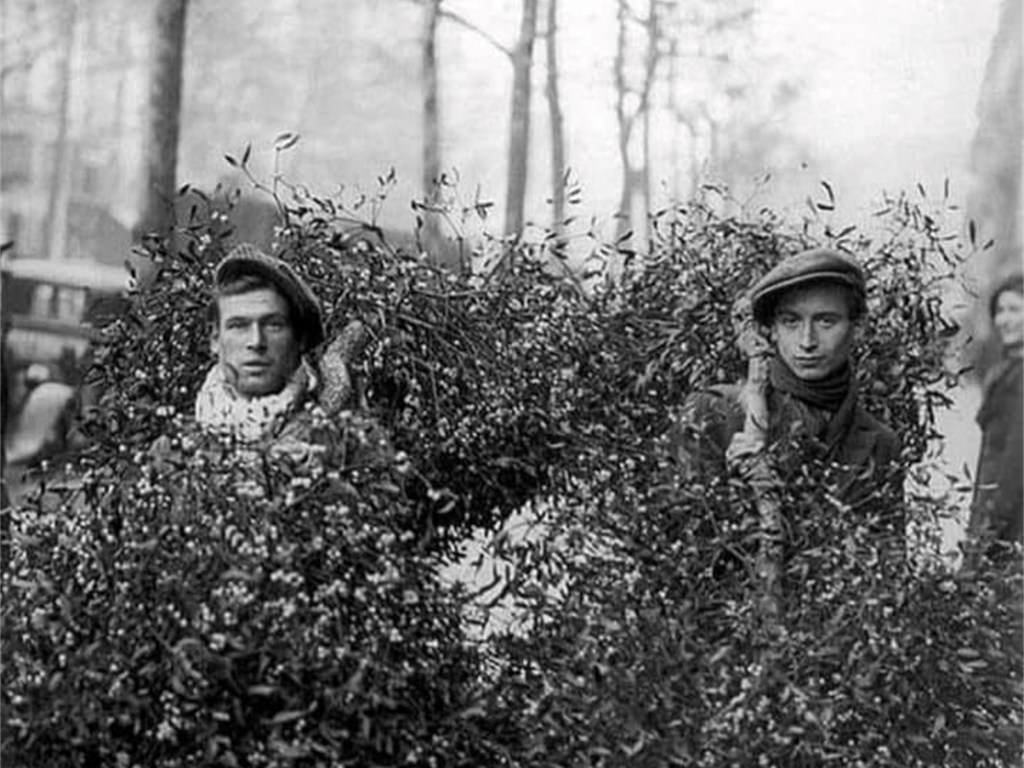
At the back of the room, in the corner, stood a baby grand piano that had been in the Mistleton family for two generations. Woody didn’t play, but every so often he’d sit on the bench and take in the view of the luxurious yet lived-in interior. He walked towards the piano, intending to drink in the scene again, when it popped into his head to lift the seat of the piano bench. Lying on top of faded holiday and other songbooks he found a dated black-and-white photograph from 1928 of two handsome young men carrying enormous bunches of mistletoe.
What struck Woody the most about one of the men in the photo was that, unlike the portrait in the hall, he looked exactly like Mistleton.


Leave a Reply